First, I apologise for the long hiatus since my last blog post but I do, at least, have a good excuse. Charlie Isitt has been visiting for the last three weeks so we took the opportunity to travel to Ladakh, a mountainous region in the far north of India.
Ladakh is in the state of Jammu & Kashmir which is famed for its beauty but also, sadly, its conflict owing to the ongoing border disputes between India and Pakistan. Ladakh is far enough east to avoid most of the India / Pakistan trouble; it instead lies close to the Tibetan border for some India / China tension instead. Although Ladakh is part of India, it was a separate kingdom (with its own monarchy) prior to independence and feels culturally very different from the rest of India. The native people are Buddhists and the high altitude of the region (Leh, the main town, is at 3500m) and mountainous landscape results in a region much more similar to neighbouring Tibet.
We booked a 10 night stay in Ladakh through a tour guide, Stanzin, who had been recommended to us by a British friend currently living in India. The plan was to relax in and around Leh, seeing local sites, for four days before embarking on a six day trek through the mountains (part of the Himalayas). Our trip was therefore full of a range of incredible and memorable experiences so I'm going for a multi blog post approach for our holiday. Here, I'll focus on the trek itself, and a report on the rest of our activities in Ladakh, and on the extreme effects of altitude on the human body, are yet to come...
Leh is famous for its outdoor and adventure activities and we wanted to do something brave and memorable, so a six day hike through areas with no road access climbing up to over 5000m seemed perfect. We wanted a real adventure but, equally, did not want to underestimate the seriousness of walking in remote areas at high (and sometimes dangerous altitude) and wanted to make our lives are comfortable as we reasonably could. We therefore enlisted Stan, our guide, and his team of one helper, one cook, one horseman and six horses. Although we would be camping, our bags and equipment would be carried by the horses and the team did all the catering, leaving us with very little to plan or worry about other than enjoying the experience.
For reasons to be explained in the "High Altitude - Danger" blog post, Charlie could not come on the trek and had a few quiet days in Leh instead. This was sad for us all, but the trek team were ready to go so Phil and I set out to the starting point of our walk through the Markha Valley, close to the village of Chilling. We passed the confluence of the Indus and Zanskar rivers on the way to the start point - a beautiful sight. We also saw lots of keen white water rafters, another popular activity in the Indus Valley in Ladakh.
Our trip was a five day walk up the Markha river, a tributary of the Zanskar river, starting at the valley floor at 3000m and crossing the 5200m pass on the final day before a steep descent back down to 3700m and to the road back to Leh. The longest day was around 20km which was fairly flat, with shorter days at the end of the trek where we climbed steeply at punishingly high altitudes. The trek route was fairly well known and we saw (and chatted with) several other walkers at the camp sites, but we were usually the only humans in sight and it felt remote. We did see others doing the route without a guide but I wouldn't recommend it. It's not hard to navigate, but hard to get out or get help if anything goes wrong.
Day 1- Chilling to Sku


The only panic of the first day for me was an apparent infestation of wasps which buzzed around everywhere in the valley. This was not good news for someone scared of wasps. After a good half an hour of flapping, our crew convinced me that they were wasp shaped hoverflies that don't bite or sting. Phew! They didn't attack me so I was happy after that.
Day 2 - Sku to Markha


 The Kang Yaze peak (I or II, I'm not sure) appears on the horizon. Kang Yaze 1 is 6400m and Kang Yaze II is 6170m. To compare, Ben Nevis is 1344m and Everest is 8848m.


At the end of day 3, we stopped at a quiet campsite at 4000m, at the start of the big ascent...
Day 4 - Thachungste to Nimaling


Day 5 - Over the pass


 The incredible descent which helped to restore my oxygen equilibrium. Unfortunately, the photos don't do justice to the colours. Much of the rock was bright green - it made me think of a cross between the Wizard of Oz and The Lord of the Rings.




Ladakh is in the state of Jammu & Kashmir which is famed for its beauty but also, sadly, its conflict owing to the ongoing border disputes between India and Pakistan. Ladakh is far enough east to avoid most of the India / Pakistan trouble; it instead lies close to the Tibetan border for some India / China tension instead. Although Ladakh is part of India, it was a separate kingdom (with its own monarchy) prior to independence and feels culturally very different from the rest of India. The native people are Buddhists and the high altitude of the region (Leh, the main town, is at 3500m) and mountainous landscape results in a region much more similar to neighbouring Tibet.
We booked a 10 night stay in Ladakh through a tour guide, Stanzin, who had been recommended to us by a British friend currently living in India. The plan was to relax in and around Leh, seeing local sites, for four days before embarking on a six day trek through the mountains (part of the Himalayas). Our trip was therefore full of a range of incredible and memorable experiences so I'm going for a multi blog post approach for our holiday. Here, I'll focus on the trek itself, and a report on the rest of our activities in Ladakh, and on the extreme effects of altitude on the human body, are yet to come...
Leh is famous for its outdoor and adventure activities and we wanted to do something brave and memorable, so a six day hike through areas with no road access climbing up to over 5000m seemed perfect. We wanted a real adventure but, equally, did not want to underestimate the seriousness of walking in remote areas at high (and sometimes dangerous altitude) and wanted to make our lives are comfortable as we reasonably could. We therefore enlisted Stan, our guide, and his team of one helper, one cook, one horseman and six horses. Although we would be camping, our bags and equipment would be carried by the horses and the team did all the catering, leaving us with very little to plan or worry about other than enjoying the experience.
For reasons to be explained in the "High Altitude - Danger" blog post, Charlie could not come on the trek and had a few quiet days in Leh instead. This was sad for us all, but the trek team were ready to go so Phil and I set out to the starting point of our walk through the Markha Valley, close to the village of Chilling. We passed the confluence of the Indus and Zanskar rivers on the way to the start point - a beautiful sight. We also saw lots of keen white water rafters, another popular activity in the Indus Valley in Ladakh.
Our trip was a five day walk up the Markha river, a tributary of the Zanskar river, starting at the valley floor at 3000m and crossing the 5200m pass on the final day before a steep descent back down to 3700m and to the road back to Leh. The longest day was around 20km which was fairly flat, with shorter days at the end of the trek where we climbed steeply at punishingly high altitudes. The trek route was fairly well known and we saw (and chatted with) several other walkers at the camp sites, but we were usually the only humans in sight and it felt remote. We did see others doing the route without a guide but I wouldn't recommend it. It's not hard to navigate, but hard to get out or get help if anything goes wrong.
Day 1- Chilling to Sku
Our bags, tents and provisions waiting to be loaded onto our team of horses
First team shot (Stan took a lot of team photos...) close to the river and start point
Despite the very low rainfull in the region, the land is lush near the river owing to irrigation. It was harvest time in Ladakh, much of which is done by hand, to bring in the main barley crop before winter.
Meeting another team of fully laden horses as we walked through the valley
Stupas (kind of Buddhist shrines containing relics which you should walk around in the clockwise direction)
Relaxing at our camp at Sku after an easy first day with mint tea, biscuits and cake. At this point, we realised that the catering was going to be good...
Our second pre-dinner snack was noodles in a fresh vegetable broth
Our brightly coloured accommodation for the next five nights. Roasting in the day when the sun was out. Freezing as soon as the sun went down.
We always camped close to the river, our washing facilities for the trek.
The crew had a bigger tent and managed to cook a feast each evening on only three gas hobs. We started with Indian food but they managed soup, pasta, potato wedges, dumplings, chinese food and even cake over the course of the trip. We did not go hungry.
The only panic of the first day for me was an apparent infestation of wasps which buzzed around everywhere in the valley. This was not good news for someone scared of wasps. After a good half an hour of flapping, our crew convinced me that they were wasp shaped hoverflies that don't bite or sting. Phew! They didn't attack me so I was happy after that.
Day 2 - Sku to Markha
My British Airways First Class pyjamas saw me through the night in a tent. Cold mornings were helped by tea arriving at the tent door at 7am and a good hot breakfast.
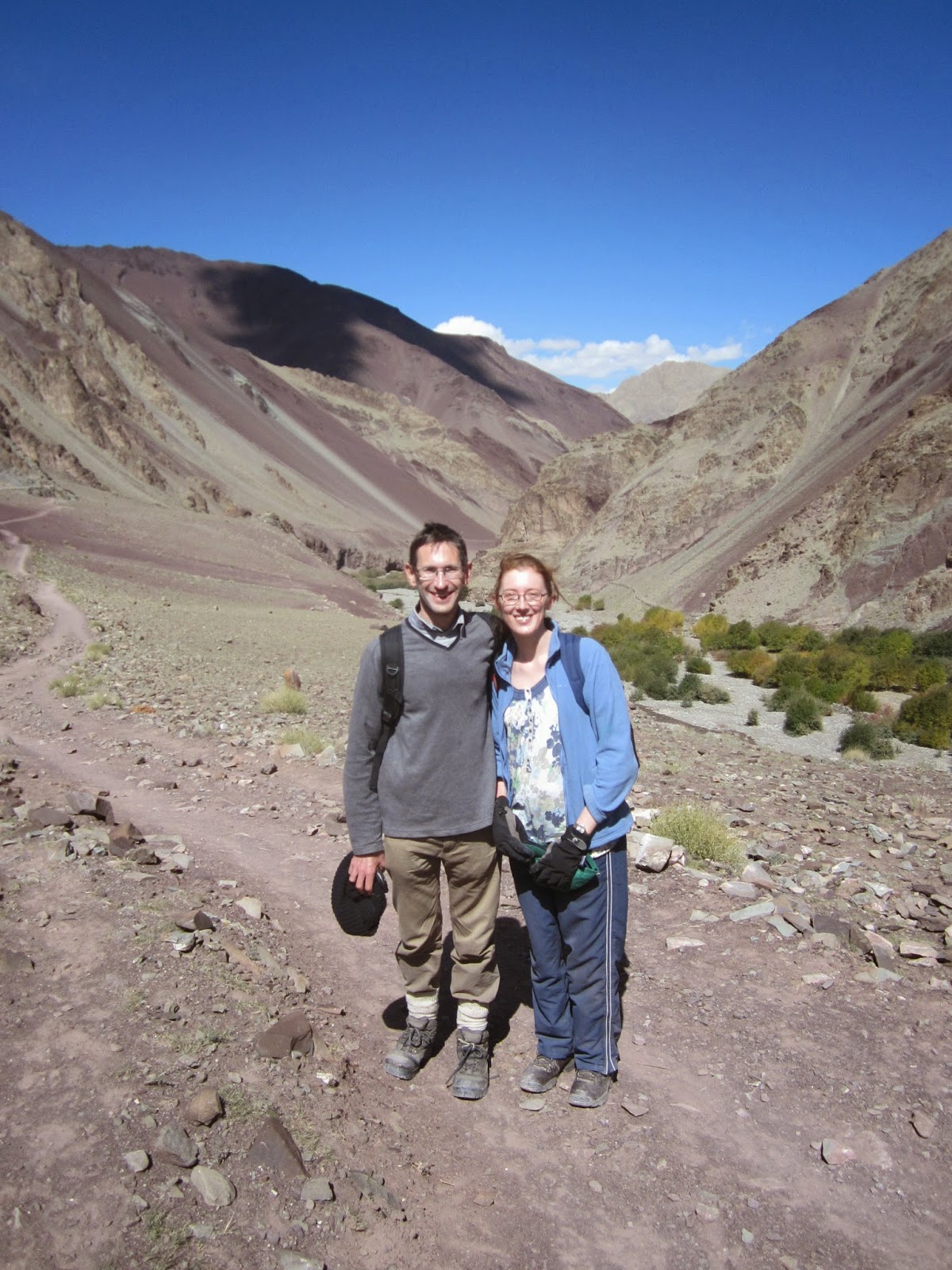
On our way. The landscape on day 2 was fairly rocky with large crags rising up on both sides of the valley.
Phil is looking a bit ghost like owing to the large amount of suncream that we both wore throughout. The sun is very strong and there was no cloud cover.
Our man Stan, who did an exemplary job of looking after us.
Some greenery lining the river.
We removed our shoes to cross the river shortly before Markha. This was freezing but wonderfully refreshing after a long walk. The river level rises a lot during the day as the water that flows down is melted snow from the mountains. It is very clear, with a wide spectrum of colourful rocks (this area is a geologists dream).
A pack of horses making the river crossing look a lot easier than I did.
Relaxing at our camp. The building in the background is a homestay, the alternative to camping along the route.
Day 3 - Markha to Thachungste
Even more spectacular rocks
There were "tea tents" every few kilometres run by local people living in the valley. Their homes are very remote and cut off entirely for months during the winter. This little boy was very curious and enjoyed having visitors.
The peak in all its glory. We would get much closer on the next day.
Another tea tent location. This time guarded, curiously, by a yaks head. We had lots of stops for tea which was required as walking at high altitude is very tiring.
A Dzo - a cross between a cow and a yak- which seemed to be a popular combo in these parts.
After three days with no washing facilities, my hair had turned to straw and I was desperate to wash it. The river was the only option. The water was freezing but the sun very warm so it was great overall just not very private for full body washing. I thoroughly enjoyed my shower at the end of the trek after five increasingly smelly days without one.
We didn't have any toilet facilities for five days either which was problematic but a popular conversation topic for Philip. The less said about that the better...
At the end of day 3, we stopped at a quiet campsite at 4000m, at the start of the big ascent...
Day 4 - Thachungste to Nimaling
Although the walk was relatively short at 2.5 hours, we climbed from 4000m to 4900m, then back down to 4700m where we camped. Walking uphill at this altitude was very hard and I found it difficult to catch my breath, even when trudging along very slowly. Frequent rests were required.
Evidence of the presence of other walkers. This was a particularly awesome viewpoint.
At 4900m next to a lake reflecting the Kang Yaze II peak.
There were regular piles of stones including ancient Tibetan carvings. The language of Ladakh is Ladakhi which is very similar to Tibetan.
Our horses overtook us for the first time. Evidence that we were walking particularly slowly!
Our campsite, a huge plateau, with a friendly baby dzo.
The best sheep ever. He was very cute and very fluffy!
Life at 4700m was cold, to say the least. After a warming dinner, I slept in five layers of clothes plus a woolly hat, a sleeping bag and a thick blanket, which just about kept me warm enough.
The long climb from our camp to the Gongmaru pass at 5130m
I found this extremely physically draining. I was walking painfully slowly and needed to rest every minute or two. Stan said that we were quicker than average though which makes me feel a bit better.
Made it! Although I was feeling very rough at the tough. My body wanted to get to lower ground and a more oxygen rich environment as soon as possible.
Stan the man. Apparently not tired at all.
Group hug before the descent.
It was really quite snowy and cold at the top, another reason to get down quickly.
A rock gate
Going down...
Close to our final camp and feeling very happy that we'd made it through in one piece!
Final camp and end of the trek
Phil's 10 year old walking boots were a little worse for wear. We left them in Leh.
Charlie joined us for the final night camping so had a taste of the trekking experience. Here is our crew from L to R - the horse man, Phil,me, Stan, Charlie, our cook and our helper.
Amazingly, the team managed to bake a cake for us for breakfast. We were impressed.
Our final trekking breakfast
With our cook, driver and helper before returning to Leh


