Saturday, October 26, 2013

A New Indian Bellringer

It's been a while since my last blog post, mainly owing to busy-ness of work and as Phil and I have just returned from a trip to the UK.  It felt a little strange returning to the UK after four months away - the streets of London seemed immaculate and very quiet compared to Mumbai (even in rush hour!) - but we thoroughly enjoyed catching up friends and attending a wedding in Glasgow.

It seemed to rain a lot in Glasgow, particularly when we were walking up a Munro (Ben Lomand), and looking up the UK rainfall stats confirmed for me that the average annual rainfall in Glasgow (1200mm approx) is twice that of London (600mm approx).  It's interesting to compare, however, that Mumbai can receive close to 1200mm (900mm to 1000mm at least) in one month of heavy monsoon rain...The fact that it's significantly hotter in Mumbai means though that you dry off much more quickly!

We flew back to India on Tuesday this week, our second wedding anniversary, for which Phil parted with some of this BA miles to upgrade us to First class, a big treat for us both.  We therefore had an excellent day (although our wedding anniversary was 4.5 hours short of a full day!) and felt relatively fresh upon returning to the city.

 Preparing for take-off

 During lunch...the air hostess kindly left the bottle on the table for Phil

A dash of cheese - hard and expensive to buy in Mumbai!
 
Moving on to the title of this blog post, on Friday afternoon we had an excursion down to the tip of South Mumbai, to the Tata Institute for Fundamental Research ("TIFR") in Colaba.  Phil has now visited this institution several times with work and, on a previous visit, the topic of our more unusual hobby, bell ringing, came up in conversation.  Philip explained the connection between mathematics and bell ringing and was invited to deliver a host a one hour colloquium on the subject, to an audience of leading mathematicians and scientists, and volunteered that I would present with him.  Needless to say I was not consulted about this beforehand and was disgruntled to find that I'd been described as a group theorist (having now forgotten most of what I learnt in my degree), but it sounded fun and something different, so I was happy to go ahead. 
 
We spent the previous two evenings drafting the presentation (I admit that Phil did the bulk of the work) which includes sections on the engineering of bells hung for change ringing, basics of change ringing, examples of applications in group theory, a challenge for the audience (with a prize) and the background of the bells hung at the Afghan Church, located just around the corner in Colaba.
 
In addition, we took along our handbells to include some live demonstrations of change ringing within the presentation.  This was where our major challenge arose - we wanted to demonstrate ringing on more than four bells, yet we are the only handbells ringers that we know of living in Mumbai.
 
Having not yet mastered ringing more than two bells each, we initiated a new Indian ringer - our driver Sagar!  We first tried ringing handbells with him a few weeks ago when it was clear that he had good coordination and, after a few practice sessions, Sagar can now ring Plain Hunt on 6 on the tenors, so played a key part in our presentation. After some initial confusion and a restart, we rang 12 changes which closely resembled Plain Hunt.  I'm not quite sure what Sagar thinks about his new driverly duty, but he certainly likes the bells and loved the opportunity to perform in front of an audience of 150 people in TIFR.  He will never have had an experience like this before so including him made the presentation more special.
 
Post-talk photo shoot
 
The people at TIFR made us all feel extremely welcome and the level of interest and attendance at the talk was brilliant.  We had tea and biscuits afterwards where many people had questions about ringing; the talk certainly seemed to be a success.  Phil's hoping that some of the audience will take up his challenge - to compose a bobs-only peal of Erin Triples (!) - for the 25000 rupee prize offered by us in the presentation.
 
On top of that, we were lucky to have the opportunity to walk around the TIFR campus, which covers a large area of prime land in South Mumbai, included a stretch of coastline looking out to the Arabian Sea.  Taking a stroll and watching the sunset was relaxing; those who live and work at TIFR are very fortunate to have so much space and tranquillity in this hectic city.
 
Sunset looking out to sea from TIFR (taking with a slightly smudgy camera)

Lawns in the TIFR grounds 

Sagar, our kind host Sudipta, Phil and me

 
We hit rush hour Mumbai traffic heading home and therefore chose to stop for dinner (veg Gujarati food) on the way home.  We treated Sagar to dinner, following his handbell success, which he seemed to enjoy.  He is usually insistent that no Indian food can possibly be as good as his mother's cooking, but did admit, upon tasting, that the food we chose was pretty good.


Friday, October 11, 2013

Delightful Delhi

Following our early morning start for our 10k run on Gandhi's birthday last week, we had another 5am start on Thursday morning, this time to travel to Delhi for work.  Given that we both needed to travel to Delhi at the start of October (me to recruit clever students and actuaries, Phil to visit clever scientists), we were able to coordinate these and arrange to spend the weekend following our trip as tourists in the city.

Thursday / Friday were long and busy days and went by in a blur, and we were both shattered when we reached our hotel on Friday evening, spending the first non-work evening in Delhi by going to sleep early as Phil had a headache.  Not the most exciting start to our Delhi adventure, but this did mean that we were ready for an action-packed day exploring the city on Saturday.

There were a couple of memorable events before the weekend... 

First for me as, upon arriving in Delhi, my colleague Megha and I had a couple of hours free before our first presentation.  We went to visit Megha's grandparents (who are 80) for lunch which was brilliant.  I was treated to a home-cooked feast and watched Megha's grandmother cook the meal which was fascinating.  My main learning points were that (i) Indian cookery doesn't have to be complicated to be tasty; (ii) a pressure cooker is an essential part of an Indian kitchen; and (iii) becoming an expert roti maker has been added to my life ambitions.

Phil's experience was equally memorable but less positive and probably led to the headache.  We booked a budget hotel for the weekend stay (a bit like a Travelodge) which was cheap but well located and perfectly clean, and good value for what we paid.  Upon finishing his final work appointment, a retired professor accompanied Phil to the hotel to make sure he did not get lost, and they unfortunately struggled to find it, not helped by the incorrect phone number on the booking confirmation voucher.  This isn't the sort of thing that we would think twice about, but when Phil finally arrived to check in, the professor started a shouting match with the hotel manager over the phone number issue.  This escalated and led to a big crowd of hotel staff gathering, tempers being lost, and the professor and hotel manager threatening to "block" each other.  According to Phil, he stood to the side looking embarrassed until someone showed him to the room.  On the positive side, the message given to the hotel manager seemed to be that Phil is a esteemed western guest and should be treated with respect (!).  We were treated very nicely for the rest of our stay; the hotel seemed keen to keep us happy.

For some reason, my vision of Delhi had been of somewhere rather scary and crime-ridden although my actual experience was quite contrary to this expectation.  Unlike Mumbai, Delhi is a grand and (in the case of New Delhi) beautifully designed city.  Some of the architecture is fabulous and Delhi has the key thing lacking in Mumbai - space - we saw no obvious slums around the city and New Delhi in particular is ostensibly much cleaner.  I'm certainly not saying that I preferred Delhi to Mumbai, not at all, but I can't deny that I was impressed.

Further, Delhi is an old and historic city.  Delhi is the culmination of seven cities, plus New Delhi created as a celebration of British rule at the start of the 20th century.  Like Rome, there are amazing monuments or ruins round every corner and lots to see as a tourist.  We packed a lot in, but hardly scratched the surface.

We hired a car from the hotel for a full day on Saturday, and were lucky to have a charming driver called Gitish (nickname "Sunny") who had great English and was an excellent guide.  After a (rather deep fried) breakfast in the hotel, we travelled to Humuyan's Tomb, explored the winding streets of the Nizamuddin area and ambled round Lodi Gardens.  We travelled to see Gandhi's memorial (set in beautiful gardens including memorials to others including Rajiv Gandhi) amongst big crowds of school children.

The spectacular Humuyan's Tomb...

...and again

Mini-tomb in the Humuyan's tomb complex

In Lodi Gardens

"Naughty" (according to its owner) goat in Nizamuddin area

Very Zen Garden (in Lodi Gardens)

Shrine to Gandhi - a very simple design

The man himself

After this hectic morning, and feeling a bit over-heated, we had a late lunch of tea and cake in the Taj.  We kept been told by locals that we'd travelled to Delhi at just the right time, not too hot and not too cold, but frankly it was boiling.  I started melting after more than 15 minutes outside an air-conditioned environment so thoroughly enjoyed an hour in a relaxing and cool cafe (with very good tea and cake!).

Tea, ice tea, chocolate cake and bonus madeleine cakes

 Unfortunately named restaurant in the Taj

Tea over, we continued our Dehli tour with a trip to Jantar Mantar (English equivalent of "Abracadabra"), an amazing complex of old astronomical instruments including enormous sundials.  Sadly, the instruments are now overlooked by tall buildings from all sides, rather spoiling the sundial set-up, but this was still a fascinating place to visit.

A very big gnomon

 Another astronomical gadget

After the obligatory trip to a tourist shop to please the driver, we were dropped off at the Red Fort to explore before sunset.  The famous Red Fort is an awesome structure with many historic buildings contained within it and well worth a visit.

Outside the main wall of the Red Fort

One of the many palaces inside the Red Fort, once the home of the Kohi-Noor diamond and Peacock Throne (both now in the UK)

We met with Megha and her husband Aditya who had kindly come to meet us to show us the sites, sounds and food of Old Delhi before we went to see the Sound and Light show within the Red Fort.  Old Delhi is a crazy, crazy place; especially the main street Chandni Chowk.  We travelled from the fort down Chandni Chowk by cycle ricksaw, a first for us, and the density of humanity on the street was incredible.  The traffic didn't really move, you just progressed by squeezing into a gap in front of you wherever possible.

Traffic carnage on Chandhi Chowk

Our destination was Gali Paranthe Wali, a narrow lane famous for its fresh parathas - a flat deep fried bread available with a wide range of stuffing options.  We squeezed into a packed open-fronted cafe and feasted on fresh parathas which were served with several (very spicy) veg curry accompaniments.  We ordered a lot of food, and struggled to spend 100 rupees per head.  The hygiene didn't look great, but vegetarian food served piping hot is safer than many other street foods and we were both fine afterwards.

Our dinner

Back at the Red Fort, we enjoyed a sound and light show which explained the different buildings in the fort and provided an interesting, if distinctly anti-British, history of Delhi.  Several people we met did admit that the British (specifically Lutyens) gave Delhi some fantastic architecture, but the favour generally ends there!

We flew back from Delhi to Mumbai at lunchtime on Sunday but managed to squeeze in another famous historical site, the Q'utb Minar, before leaving the city.  South of the city, this site includes the remains of the 7th city of Delhi, at the centre of which is a spectacular tower which dominates the complex.  The quality of the ruins is astonishingly good and the site was teeming with visitors.

Close to the tower.  The carvings are in immaculate condition.

Q'utb and surrounding tombs

Posing

Our journey back to the airport was easy; the roads in Delhi are *almost* ordered and reminiscent of a western city at times.  I thoroughly enjoyed our first trip to Delhi and will look forward to going back again.

Thursday, October 10, 2013

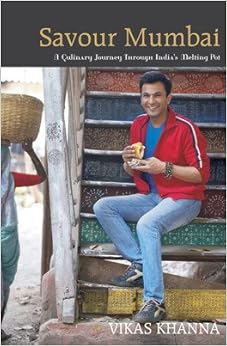
My new favourite cookery book

Whilst killing time browsing in a bookshop at Mumbai airport before flying to Kerala at the end of September, I found my new favourite cookery book.


"Savour Mumbai - A Culinary Journey Through India's Melting Pot" is written by an Indian chef, Vikas Khanna, who is originally from Amritsar but has spent most of his career abroad.  He has, however, spent periods of time living in Mumbai and exploring the huge variety of the culinary offerings of this city.

The book is structured around Mumbai's restaurant scene and includes a few dishes from a variety of restaurants (28 in total) around the city.  Although all food is "Indian", the style of food in each restaurant is distinct (and mouthwatering!) and the book illustrates the huge range of Indian food that you can eat here.

The restaurants range from kebab stalls on the street, to top-end restaurants in 5* hotels, and having now been through the book several times, I now have a goal:  to eat in every restaurant and cook at least one dish listed under each restaurant whilst in Mumbai.

The range of recipes included is super.  This includes main dishes, savoury snacks, desserts, sweets, drinks (hot and cold), rices, breads.  Further, there is section including recipes for lots of different and delicious types of street food at the end of the book.  If I can master the dishes in this book, I will be a happy eater at home forever more.

For those who are visiting Mumbai, or just interested in the range of food on offer, here is the restaurant (my target) list.  We've already been to the ones in bold, there are quite a few to go!

Bademiya Seekh Kebabs - Succulent meat kebabs
Bagdadi Restaurant - Mughlai-style
Banana Leaf - Pure vegetarian south Indian
Dakhin Culture Curry - Home-style traditional south Indian food, veg and non-veg
Diva Maharashtracha - Home-style Maharastrian cuisine
Goa Portuguesa - Goan, Portuguese and Konkani food
Good Luck Restuarant - Irani cafe, staples include kheema pav and haleem
Govinda's Restaurant - "Satvik" food, based within a temple complex
Ideal Corner - Parsi and Irani
Kangan - Rich northern cuisine, mainly in the book for the view
Kebab Korner - Meat kebabs (unsurprisingly) and fresh roti
Kebabs and Kurries - Tandoor cooking from India and Central Asia
Khyber - Royal cuisine of North-West frontier.  Recommended for Raan.
Lucky - Biryani and other Indian and Mughlai food
Mahesh Lunch Home - Mangalorean seafood (speciality is crab)
Nawab Saheb - Rich Mughlai food
Noor Mohammadi - Muslim cuisine, including GHee Dal and Methi Kheema
Oh! Calcutta - Bengali cuisine, seafood speciality
Raj Bhog - Thali
Saffron - Tandoori food from Hyderabad and Awadh
Soam - Pure veg Gujarati and Rajasthani food
Soma - Pan-Indian cuisine, focuses on areas around the Great Trunk Road
Soul Fry Casa - Goan seafood
Temple Flower - Primarily authentic Punjabi food
Trishna - Mangalorean cuisine, seafood speciality
Vrindavan - Pure veg south Indian

I will provide updates as I progress through my challenge!

The book is available on amazon, but is much cheaper is bought in an Indian bookshop.

http://www.amazon.com/Savour-Mumbai-Culinary-Journey-Through/dp/9382618953

Wednesday, October 2, 2013

Running 10k in India

In our 3.5 months in India to date, our exercise has been almost exclusively in the gym or swimming pool.  This is a change of lifestyle for us; in the UK we walked, ran (Phil more than me) and cycled outside, but that just isn't a practical option in Mumbai.  The traffic, lack of open spaces and air quality makes running outdoors much less straightforward.  It's not impossible, but we've stuck to indoor environments during the monsoon season.

A few weeks ago, we signed up for an event called Footsteps4Good.  This is a 10k charity race (or walk if you prefer) for which the entry fee is a minimum 2000 rupee donation to an NGO of your choice.  The race is held in the Bandra Kurla Complex which is close to our apartment and is run early in the morning on 2 October, an Indian Public Holiday (for Gandhi's birthday) when traffic is at a minimum.
 
Phil and I both entered and ran for the charities Magic Bus and Nanhi Kali respectively.  Magic Bus supports child education through sport, whilst Nanhi Kali provides education for girls from poor backgrounds who would not otherwise have the opportunity to attend school.  A 2400 rupee donation to Nanhi Kali provides the support required for one girl to attend school for a year.  Girls are often removed from school early to help at home in certain communities; this NGO is working for a very worthwhile cause that I was keen to support.

Phil has had a dodgy leg (pulled a hamstring) for the last few weeks so was apprehensive about his ability to complete a race but decided to give it a go.  The meeting time for the race was 6am (yes, 6am, on a Bank Holiday) so we were up very early to travel to the starting point.

There were over 1200 participants in total for both the 10k race (starting at 7am) and 10k walk (starting at 730am).  We arrived at the starting area in the dark when it was relatively cool and watched the sunrise (and felt the temperature soar) as we approached the start of the race.  In typical Indian style, we set off late as there was a child choir working though its repertoire (which was admittedly very cute) followed by the National Anthem before the runners lined up to start at 715am.

Several random events followed; the starter "test" fired his gun prompting a false start and recall into the running pen, which has turned into a muddy bog owing to late monsoon rain.  Whereas you would usually expect your fastest runners to stand at the front, a whole class of children from an orphanage were determined to set off first.  They did admittedly have a great sprint start but unfortunately flaked out after 200m or so!

Once we finally got going, I thoroughly enjoyed the race and managed a pretty steady 5 minutes per kilometre from the start, with a little slowing up at the end when I was melting.  In terms of the race itself, I knew that the first three women would win a cash prize for their NGO in advance, but I couldn't see any women ahead or behind me for the whole thing!  As it turns out, I was in 3rd place throughout with 2nd a long way ahead and 4th a long way behind.  The race was really well organised and signposted, and a nice marshall on a motorbike came to tell me I was third 1km from the finish and rode next to me with "distance to go" updates.  I found the distance and speed fine but the temperature made running a lot more difficult than in the cool of the UK.  There were water stops every 1km which was necessary and I was extremely hot by the end of it.  Running in Indian conditions is not trivial and not to be taken lightly.

One extra quirk was that the distance was close to 10.5km.  There were no official times, but I reckon my 10k time was a bit over 50 minutes and the whole thing about 53 minutes.  I'm keen to improve - more time on the treadmill is required! Phil was very pleased that his leg held up and he came in as the 4th man in 47 minutes approx, though found the temperature extremely tough.

I did a few Parkruns before leaving the UK where, in general, the people running around me are fairly experienced at pacing themselves.  The race today was much more bizarre.  On minute, someone would sprint past you only to start walking a few minutes later!  Saying that, the male and female winners were both really speedy and very impressive under the conditions.

Once we'd finished the run, we spent a while cooling down and chatting to other participants before the presentation ceremony where I received a medal and some lovely flowers.  I was also given a free breakfast in the 5* Trident hotel afterwards.  We went along there after the presentation.  It's the first time I've eaten breakfast in a smart hotel dressed in soaking wet running gear including short shorts with legs covered in mud!  They were expecting us and didn't seem to mind too much.

The presentation ceremony was a little eventful because the man who had come 2nd had been taken off to hospital (eek!), presumably with heat exhaustion.  An NGO representative dressed as a clown collected the flowers and medal on his behalf.  Phil was keen to get bumped up to 3rd as he'd completed the race without requiring hospital treatment, but it wasn't to be.  Here are a few post-race pics:
My first ever podium experience!

 Post-race after initial cooling period


With medal and flowers

Two male runners plus clown

Post-run breakfast


The prize for coming 3rd is 30,000 rupees (£300) for my NGO.  I'm really chuffed about this.  That's enough for 12 girls to go to school for a year.

Aside from this NGO money, the best bit about the morning was meeting several friendly people and learning about the activity of the NGOs and running opportunities in Mumbai.  We hope to continue to meet people and get involved in running circles soon.

Our first trip to Kerala

In a continuation of our bid to see as much of India as we can in our time here, we spent last weekend in Kerala.  Phil needed to travel there for work so arrived a day earlier than me and left a day later, leaving time for a relaxing weekend between his work commitments.

In short, I LOVE Kerala.  In the middle of its monsoons (Kerala has two, one has just finished, the other about to start), it is lush, green and beautiful.  In the south of India, the climate is tropical and landscape covered with palm trees (coconuts are an important commodity) and backwaters, and all with much less litter than we've seen elsewhere in India.  The way of life is in stark contrast to Mumbai; laid-back and relaxed with no-one in a rush to get anywhere.  It is the perfect place for a weekend (or longer) away.

I took Friday off work (Phil arrived in Kerala on Thursday) and caught a lunchtime flight from Mumbai which only had about 20 people on it.  This was great, I had a whole area of the plane to myself, and we landed at Cochin airport on time where I travelled by taxi to our destination, Fort Kochi.  Fort Kochi is 40kms from the airport by road although this distance can be cut down considerably by making use of the car ferries joining different parts of the coast.  I told the taxi driver that I was happy to go on a ferry and it was all rather fun.  We were slightly delayed when the ferry driver went on a tea break; but it was all worth it to see the amazing number of cars, motorbikes and people that could be crammed onto a small ferry.  It was quite astonishing.

Car ferry - Typical arrangement is two rows of cars then as many motorbikes as you can cram into the remaining space.

I arrived our hotel, the Brunton Boatyard Hotel, shortly after 1700.  The hotel is only 14 years old and commands a beautiful position of the seafront of the old fort.  It was restructured from a former shipyard and designed to look like an old heritage property incorporating lots of original features.  This included large "punkhas" hanging from the ceiling of the reception area and colonial style wooden furniture in the rooms.  A highlight was the tea chest in our rooms which included loads of different types of tea.  A tea chest has gone on my "to buy" list!

Colonial-style furniture in our bedroom 

Tea

The hotel ran a complimentary "Sunset Cruise" around the harbour at 1730 which ended up being a private trip for me as no-one else was there!  Kochi is interesting and with many attractive features (Chinese fishing nets, lots of litle colourful boats) but, as with a lot of India, the view is somewhat spoilt by large industrial monoliths plonked in the middle of what would otherwise be a lovely view.  Ho hum.  Anyway, the trip was lovely and sunset well worth watching.  Phil arrived at the hotel shortly before 9 so we enjoyed the food in the hotel restaurant (including a lovely coconut version of creme caramel, highly recommended).


Men pulling the fishing nets in at the end of the day 

Sunset looking over the Chinese fishing nets

Fort Kochi is a historical town with British, Dutch, Portuguese and Indian influences.  After a tip-top breakfast in the hotel (which kept us going over lunch too), we spent Saturday morning wondering around seeing the sites, including the original buriel place of Vasco da Gama.  We hired an autorickshaw driver to take us round the town which was a good move in the heat of the day.  He asked for an embarrassingly low 50 rupees per hour for his services (we paid him more than this), and did a good job of taking us to the key sites and providing some history and context.  A highlight for me was visiting the ginger warehouse and spice market, the aromas were incredible, and seeing the old Chinese fishing nets (no longer used in China to my knowledge).

Brekkie

Chinese fishing net - a top attraction in Kochi 

Santa Cruz Basilica 

Jain temple, complete with many pigeons and a pigeon feeding ceremony

 Ginger being dried out in the sun

Entrance to the spice market.  We've bought some home with us! 


More spices

St Francis Xavier

After tea and cake in a lovely cafe called Teapot, we spent the afternoon cooling off in the hotel's swimming pool and then visited a local bar overlooking the harbour to have a beer and watch the sunset.  This was fairly rowdy but authentic, and once the sun had gone down, we went round the corner for a feast of Kerala fish curry and coconut prawns at a local restaurant.

Teapots in Teapot

A dip in the pool

On Sunday, we booked a half day houseboat trip along the backwaters close to Kochi.  Kerala is famous for its houseboats and its possible to hire these to travel for a week or more along the meandering small rivers and lagoons for which Kerala is famous.  We were keen to have a short trip to get a feel for whether we would go on a longer houseboat holiday in the future.

Our transport for the morning

The houseboat was fun and very relaxing though a little bizarre....our group had only four people (there were 16 seats on the boat) and we had a guide although he was strange to say the least and didn't tell us anything whilst on the boat throughout the trip.  It didn't really matter and we did visit a coconut farm and rope weaving centre, so my coconut knowledge has increased!  Travelling along the backwaters is magical, though I think I'd want a more luxurious boat if I was staying on it for any period of time.  It would be a good thing to do with a group of friends.

Making rope out of coconut fibres

I am though aware that the popularity of these trips is putting pressure on the environment.  One of the best things about our boat is that it was all manpowered (like a Oxford-Cambridge combo punt, with one person at the front and one at the back) rather than motored so at least it was good for the environment in that respect.

After a late lunch, I went back to the airport to travel to Mumbai whilst Phil stayed for work on the Monday.  We will be coming back to Kerala soon!

Symphony Orchestra of India - My first concert

Classical music is remarkably underdeveloped in India, both relative to other Asian countries as well as Europe and the US.  Classical music performances appear to be few and far between and attract only a niche audience (primarily expats and the wealthy).

This is changing, albeit slowly, and India's first symphony orchestra, The Symphony Orchestra of India, was set up in 2006.  The orchestra is based in Mumbai and plays here for two seasons each year (comprising four concerts this time) in September and February, and is now in its 15th season.  As well as bringing classical music to Indian audiences, the orchestra runs initiatives to introduce instrumental lessons in schools, particularly for the less financially-able, although this is in its early stages.   Violin lessons have been going for a while but piano and woodwind started only last year.  The mood seems positive though and access to classic music in India does seem to be widening.

We spent last weekend in Kerala and Phil travelled a night before me, so I decided to have a trip to the National Centre for Performing Arts at Nariman Point to see a concert in the September season.  I went with a work colleague (Megha) who had never seen live classic music before so it was a fun trip to introduce her to orchestral music, and me to classical music in India.

I wasn't sure what to expect but ended up having a great evening and was impressed by the quality of the venue and performance.  It probably helped that I really liked the programme (Debussy, Dukas, Mussorgsky, Shostakovich) but the quality of the playing was high and the orchestra attracts international conductors (Charles Dutoit had been conducting earlier in the week). 

The venue reminds me a lot of the Barbican (it was built in the late 1960s..) and, when inside watching the performance, I could have easily been watching an orchestra anywhere in the world.  Unusually, the venue had a remarkable lack of bonkers-ness; it was clean, well-ordered and genuinely felt like any western theatre.  Only one mobile phone went off during the performance (this is unheard of in India, they are usually ringing constantly) and I felt genuinely relaxed after an evening out at the NCPA.  One difference from the UK though is that you can get two delicious samosas for 30 rupees in the interval (much needed as we'd come straight from work) from the NCPA bar.  It's a long shot, but I'd be very happy if the Barbican or Albert Hall decided to introduce this snack system too.


View from my 800 rupee (£8) seat

The composition of the orchestra was interesting.  The musicians are primarily from overseas; my guess from the names in the programme is that the string players are mainly Eastern European and the woodwind / brass players are from the UK and US.  The programme highlighted which players are of Indian origin (there are several in the orchestra, though definitely a minority) and the programme explained that one of the orchestra's goals is to increase this proportion.

The NCPA is working hard to improve access and widen its audiences and I wish it all the best.  The resident conductor spoke for 10 minutes at the start of the concert to provide a background to each piece in the programme which was excellent and really helped Megha.  Although the composition of the audience is drawn from a narrow sector of society, I hope that this can broaden and I personally found the concert very welcoming.  The theatre was pretty full, and deservedly in my opinion.

My biggest learning point from this experience was understanding the extent to which western classical music is excluded from the education of a typical Indian child.  Megha explained that she knows what a piano and violin are, but not much more, and hadn't been exposed to any other instruments or classical music at her (I guess very good) Indian school.  Indian instruments and music are taught (voice is very important) but classical music is in its infancy.

So would I go again?  Definitely.  I will be back for the next season in February.